The Complete Checklist for Buying Electric Sub-Meters in Ontario
Choosing the right electric sub-meters in Ontario has immediate and long-term implications for the success of a metering system for unit sub-meter providers (USMP).
The best metering hardware reduces billing issues, simplifies compliance, and lowers operational overhead throughout the system's life cycle. When meters fall short in these areas, they increase service costs and strain contract relationships.
Operators need to prioritize smart meter technology that:
- Is compliant and certified to federal and provincial standards
- Will support and integrate within their existing systems and meet their building requirements
- Lowers overall cost-to-serve across installation, maintenance, and verification
- Supports long-term contract satisfaction with building owners and property managers
This checklist outlines the key factors USMPs should consider when selecting electric sub-meters for Ontario deployments.
Reviewing Measurement Canada and Ontario Energy Board Standards
Measurement Canada establishes precise specifications all revenue-grade electric sub-meters in Ontario must meet. The agency is responsible for approving meter models for billing applications, verifying proper installation, and ensuring meters are re-verified over time to maintain accuracy.
This means that in consumption billing applications, electric smart meters have to comply with the following requirements:
- Only approved meter devices can be used to create bills in multi-tenant residential uses.
- Upon installation, smart energy meters must undergo S-E-04 verification to receive the required metrological seal to begin measuring consumption for billing.
- Meters must undergo S-E-02 re-verification on six– and 10-year intervals, depending on the approved term, to stay in commission.
Smart Meter Compliance & Inspections
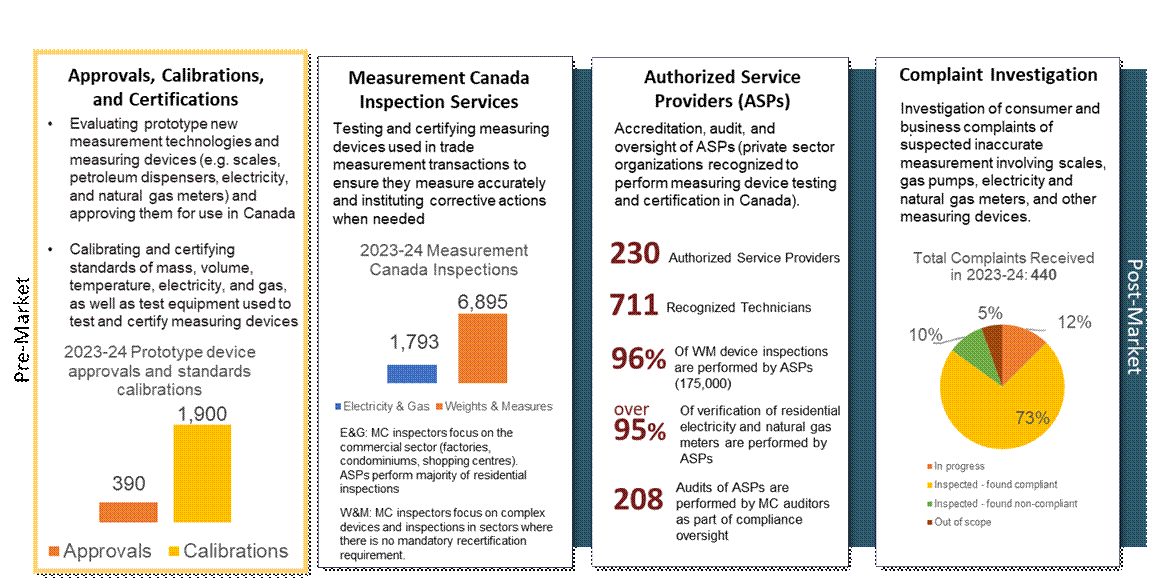
According to the most recent annual reports, Measurement Canada carried out the following:
- In 2025, nearly 200,000 measuring devices were inspected.
- In 2023-2024, conducted 1,793 inspections of electricity and gas meters on commercial sectors such as factories, condominiums and shopping centers.
- In 2024, authorized service providers, such as VIP Meter Services in Toronto, performed 175,000 meter inspections on residential electricity meter inspections.
- Over the last two years, 940 complaints of suspected inaccuracies were investigated. Of the measuring units tested, 35% required actions to resolve issues.
Ontario Energy Board (OEB) Regulations for Sub-Metering Providers
Unit sub-meter providers in Ontario operate under an additional layer of oversight from the Ontario Energy Board (OEB).
The OEB licenses operators and enforces consumer protection standards for customer service, billing, and business practices under the Unit Sub-Metering Code.
This means compliance extends beyond meter approval alone. Billing accuracy, transparency, and dispute handling also carry additional regulatory importance and can place additional responsibilities on providers by responding to reviews, undergoing inspections, and, in some cases, agreeing to pay fines.
Ontario Smart Meter Compliance Stats
In 2024, the OEB reports its complaints ranged from 0.09 to 0.46 per 1,000 customers among sub-metering providers in the province.
Billing-related issues consistently account for the largest share of those complaints received by the OEB, according to statistics published on its website, making up more than 40 percent of the 239 consumer reports the board received.
Those instances are not without impact. According to the OEB, roughly 20% of complaints are escalated for review. Of those escalated cases, 30% result in inspections. The OEB obtained assurances of voluntary compliance (ASV) in of 80% cases that reached the inspection phase during Fiscal Year 2024-25, resulting in a combined $257,096 in administrative penalties and low-income energy assistance contributions.
The Bottom Line: Smart Energy Meters Should Streamline OEB Compliance
Taken together, the practical question for providers to consider with electric sub-meters in Ontario deployments is how a unit will:
- Minimize the likelihood of billing disputes
- Simplify the inspection and re-verification process
- Limit downstream costs of disputes, regulatory reviews and field calls.
In the next section, we’ll outline the key technical and operational factors USMPs should evaluate when choosing an energy metering system.
Key Smart Meter Technical and Operational Criteria
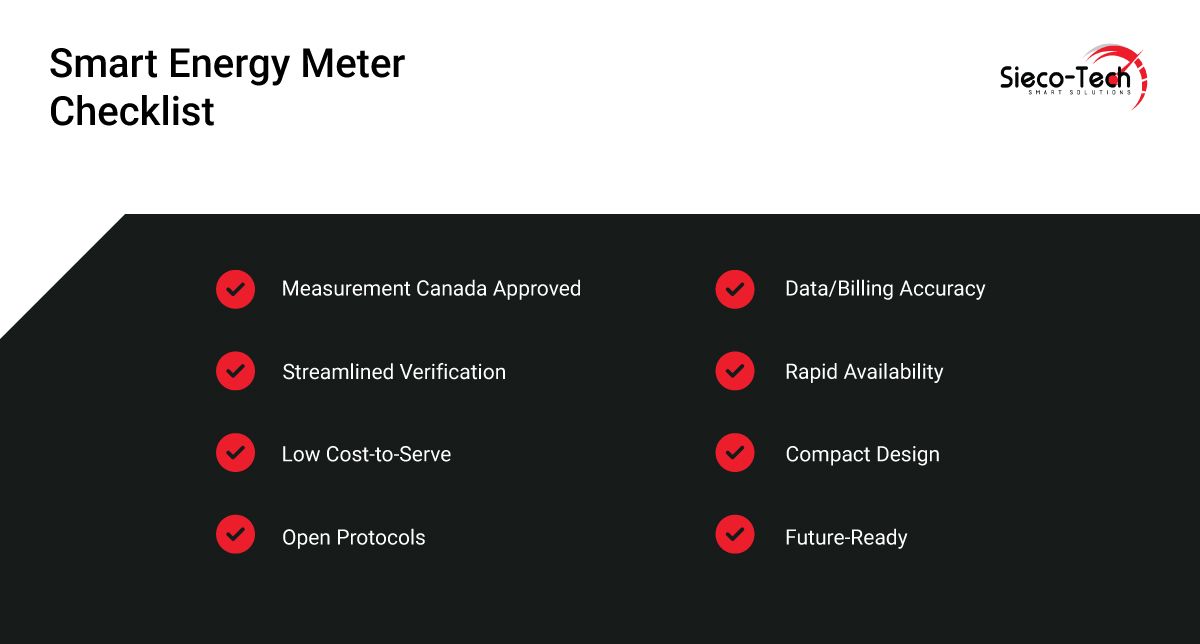
Electric sub-metering platforms should be designed to support a variety of demands for a provider. While numerous energy meter brands comply with baseline requirements, they are based on outdated technology and engineered for commercial applications.
This means there are strategic opportunities for Ontario unit sub-meter providers to set themselves apart with advanced meter hardware that supports serviceability, data access, and interoperability.
The best path to the competitive edge is for Ontario sub-metering operations to consider partnering with Sieco-Tech.
Billing Accuracy and Data Reliability for Smart Electric Meters
How reliably a meter captures and transmits interval data, how it handles missed reads, and whether its data structure supports easy traceability when billing questions arise.
Efficiency of Energy Sub-Metering Verification
Meters should support efficient inspection, testing, and re-verification throughout their complete lifecycle. A unit’s design can determine whether these steps require a full meter removal, disrupt seals, and require additional inspections to return the unit to operation.
Smart Meter Serviceability
How a unit impacts installation and field service time, battery life, and scheduled testing. Hardware that is easier and more efficient to maintain keeps costs predictable.
Sub-Metering for Ontario’s Building Stock
Many multi-residential buildings in Ontario were not designed with modern sub-metering in mind. Compact meter footprints and low-invasive installation can reduce labor and deployment complexity.
Supply Chain Reliability for Meter Procurement
Project timelines depend on hardware availability. Assess whether a supplier can meet delivery commitments to avoid unexpected delays and project bottlenecks.
Smart Meter Comms and Integration
Open communication protocols reduce data restrictions and interoperability barriers with billing systems and energy platforms. This increases operators’ long-term contract satisfaction with building owners and property managers.
Future-Proofing Smart Building Systems
When meters support remote firmware updates and adaptable configurations, they can evolve alongside regulatory changes, technology upgrades, and shifting customer expectations.
Sieco-Tech: Electric Sub-Meters in Ontario Manufactured by Industry Veterans
Based in Ontario in the greater Toronto area. Sieco-Tech engineers smart energy meter technology that is designed by industry veterans to solve the most common industry challenges sub-meter providers face, from procurement to installation to re-verification and decommissioning.
Driven by innovation, Sieco-Tech builds metering technology that creates advantages across accuracy, serviceability, and flexibility in a single platform.
This approach allows operators to:
- Reduce billing disputes through reliable, traceable meter data
- Simplify installation and accuracy using pre-manufactured CT cables, automated records, and spring-loaded terminals
- Minimize downstream costs with a modular architecture to never disturb metrological seals unless necessary
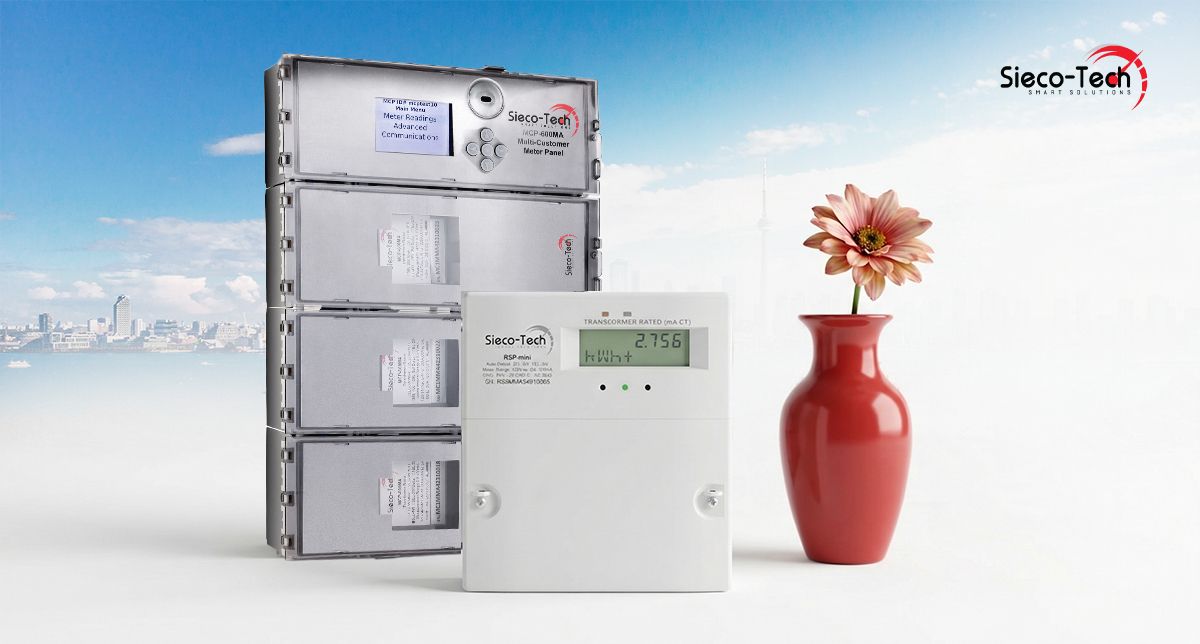
- Support Ontario real estate with compact multi-point meter panels with Sieco-Tech's MCP platform, and small wall-mount units, with the Sieco-Tech RSP, RSP-mini and CSP systems.
- Reinforce data and system control by building communications on your choice of G3-PLC, RF, or Ethernet
- Nurture long-term contracts by staying future-ready with configurable architecture and building device-agnostic, interoperable systems
- Keep Projects on Schedule with delivery timelines with high-factory capacity and 3-8 weeks for delivery.
Deploy Advanced Energy Smart Meters in Ontario
If you’re planning a new deployment or evaluating upgrades to an existing system, Sieco-Tech meters simplify federal and Ontario regulatory compliance, lower lifecycle costs, and provide advanced features that support long-term customer relationships.
Sieco-Tech can supply advanced smart energy technology for your next Ontario project.